

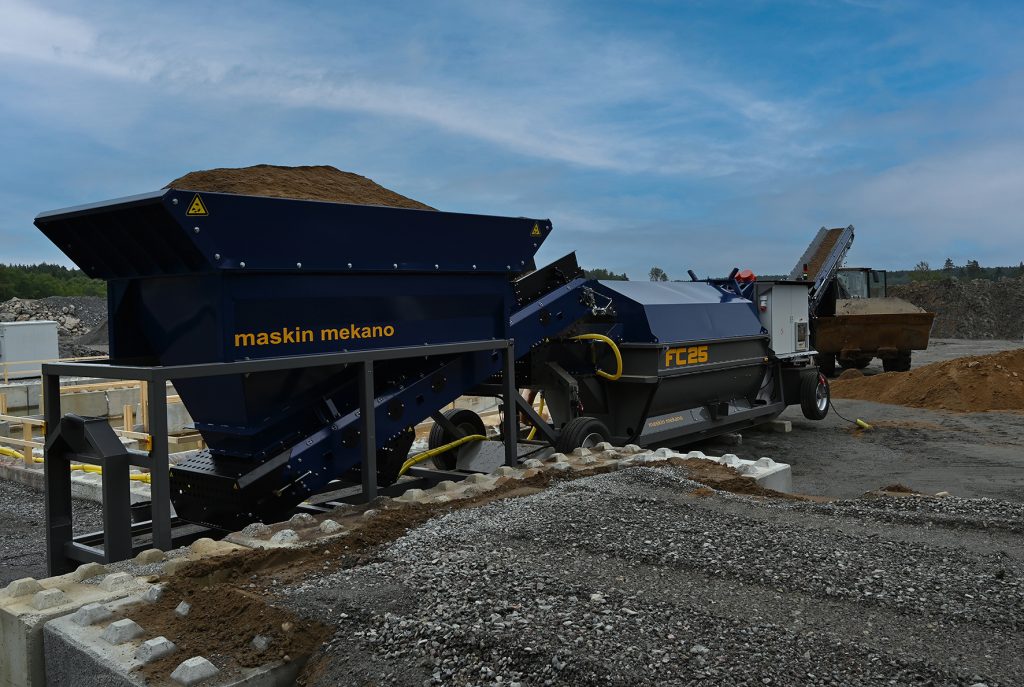
Unlock hidden value in surplus materials
Adjustment of machine sand for concrete production. Making marketable products from surplus fractions. Recycling. The need for washing and adjusting screening curves can have several causes. Maskin Mekano is now launching the versatile FC program, highly compatible with our standard machines. The combination possibilities are many. We can build the plant completely stationary, completely mobile or as a combination of both.
Water management can be designed as simply in/out or completely recircular. There are several different forms of sedimentation solutions depending on access to water and space.
Fresh water equivalent to evaporation must of course always be available regardless of the recycling rate. The process is characterized by reliability, energy efficiency and low water consumption.
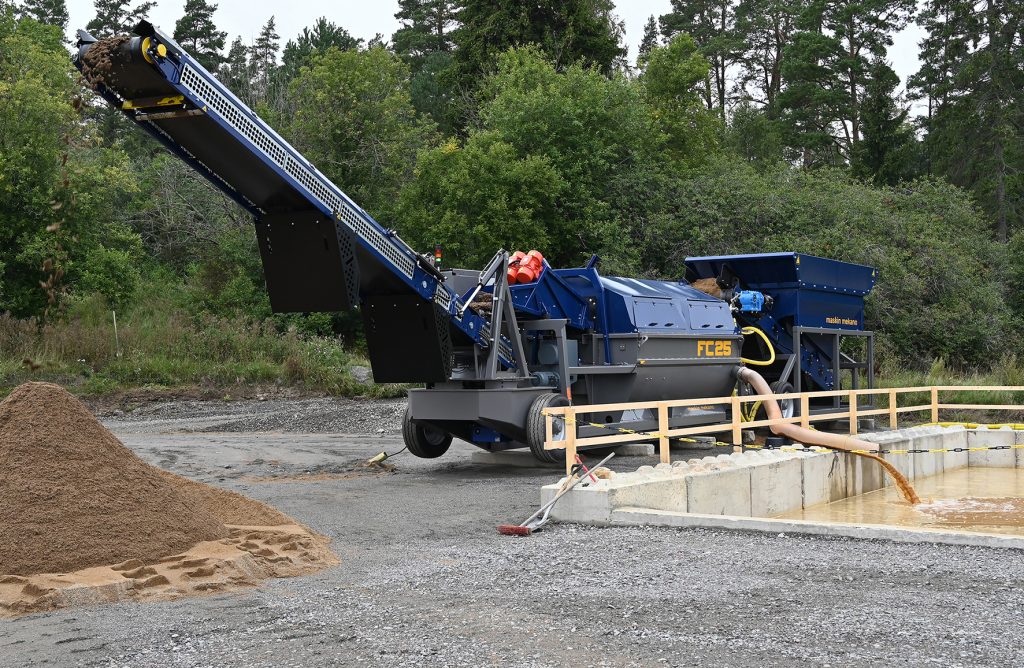
The process is characterized by reliability, energy efficiency, and low water consumption.
- Low operating costs
- Easy maintenance – few moving parts
- Easy-to-calibrate process – the result is controlled by the amount of water added
- Flexible design – stationary, mobile, or semi-mobile
- Simple frost protection – designed for Scandinavian climate
- Flexible solutions for water recycling – with or without flocculants
Q&A about Wet Screening and Wet Processing
What is wet screening?
Wet screening is a process in which water is used during screening to help separate material into different particle sizes. The water helps release fine particles adhering to coarser grains and can remove materials such as clay, silt and mortar residues.
Wet screening is often part of a broader wet-processing system that may also include sand separation, dewatering, sludge treatment and water treatment.
When is wet screening needed instead of dry screening?
Wet screening becomes relevant when moisture, fines, clay or other adhering particles prevent the required separation or material quality from being achieved by dry screening.
However, moist material does not automatically require wet processing. Maskin Mekano’s STE screen combines a powerful 12 mm stroke, low inclination and controlled screen movement, enabling efficient separation of many moist and difficult-to-screen materials. In many applications, effective dry screening can therefore achieve the required result without adding water.
If fines or contaminants remain attached to the coarser particles and affect the quality of the final product, wet processing may be the appropriate next step.
What is the difference between dry screening and wet screening?
Dry screening separates material mechanically without adding water. Wet screening uses water to release adhering fines and improve separation.
Dry screening is generally the simpler process and should not be ruled out simply because the material contains moisture. An efficient screen with powerful and controlled movement, such as the Maskin Mekano STE screen, can handle many materials that are difficult to separate using conventional dry screening.
Wet screening becomes particularly relevant when clay, silt, mortar residues or other fines remain attached to coarser particles and need to be removed to achieve the required material quality.
Is wet screening the same as washing material?
Not exactly. Washing is an important part of the process, but the objective is not simply to make the material cleaner.
Water is used to release adhering fines so that the material can be separated more effectively into defined fractions. The objective is therefore both improved separation and improved material quality.
What materials can be wet screened?
Wet processing can be suitable for recycled concrete, excavated material, construction and demolition waste, cohesive soils, aggregates and other materials containing high levels of fines, clay, silt or adhering contaminants.
The need for wet processing should be assessed based on the properties of the material and the requirements for the final product. Moist material does not automatically require wet screening, as effective dry screening can handle many challenging materials.
Why is wet processing useful for concrete recycling?
Crushed and recycled concrete can contain fine particles and mortar residues adhering to the coarser aggregate. Water can help release and separate these particles.
Where the objective is primarily to separate crushed concrete into different particle sizes, efficient dry screening should be evaluated first. Wet processing becomes more relevant when adhering fines and residues also need to be removed from the particle surfaces.
Can wet screening improve the quality of recycled material?
Yes. By removing adhering fines, clay, silt and other contaminants, wet processing can create cleaner particle surfaces and more clearly separated fractions.
This can increase the potential to use the processed material as a secondary raw material rather than treating it as low-value material or waste.
How does a wet-processing plant work?
The process starts by using water to release fine particles from coarser material. The material is then separated by wet screening.
The resulting mixture of water and fines can be treated further through processes such as sand separation, dewatering, sedimentation or sludge treatment. Process water can then be treated and recirculated.
The exact process configuration depends on the material, the contaminants present and the quality requirements for the finished products.
Do I need to invest in a large stationary wet-processing plant?
Not necessarily. Large stationary wet-processing plants can be suitable for high and continuous production volumes, but the investment and infrastructure required may be difficult to justify for smaller volumes, temporary projects or operations where the processing equipment needs to move between sites.
For these applications, Maskin Mekano FC25 provides a compact and mobile solution for wet screening and wet processing. FC25 can be a cost-effective alternative when wet processing is required but a major investment in a stationary plant cannot be economically justified.
Would you like suggestions on how we can streamline your production?

Daniel Smedenman

Calle Smedenman
