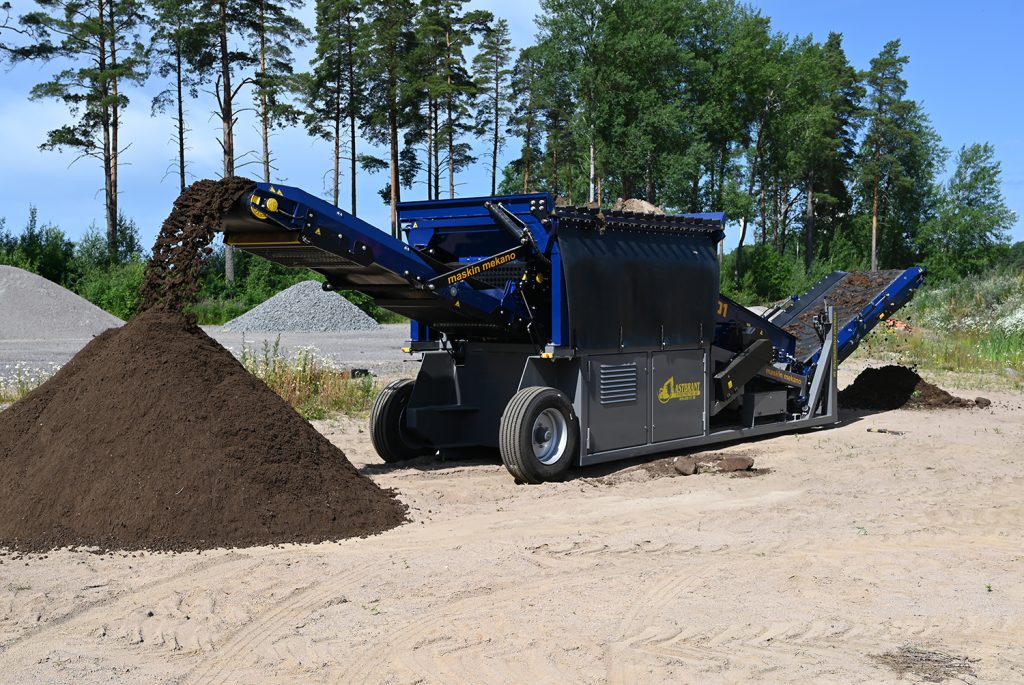
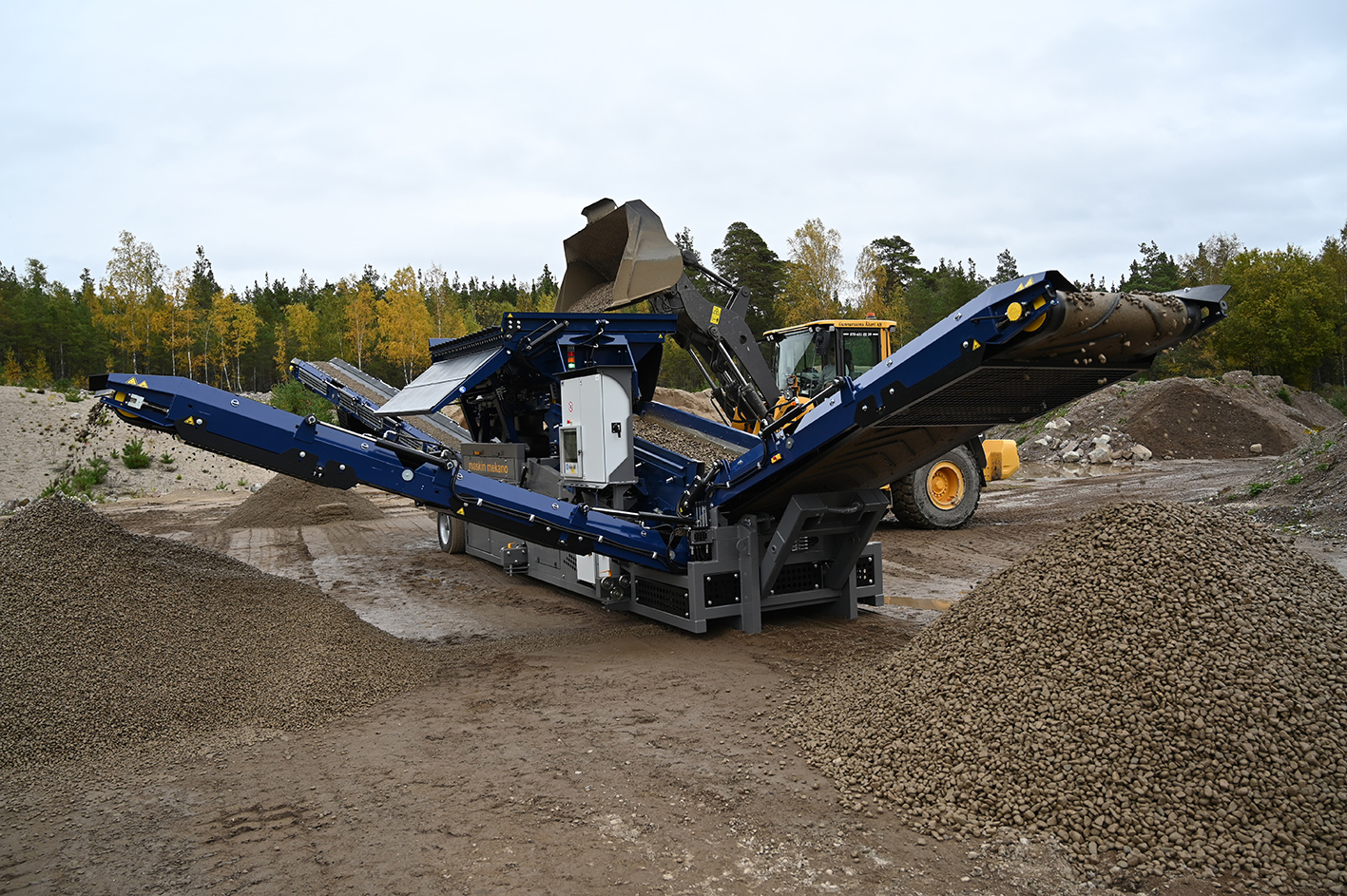
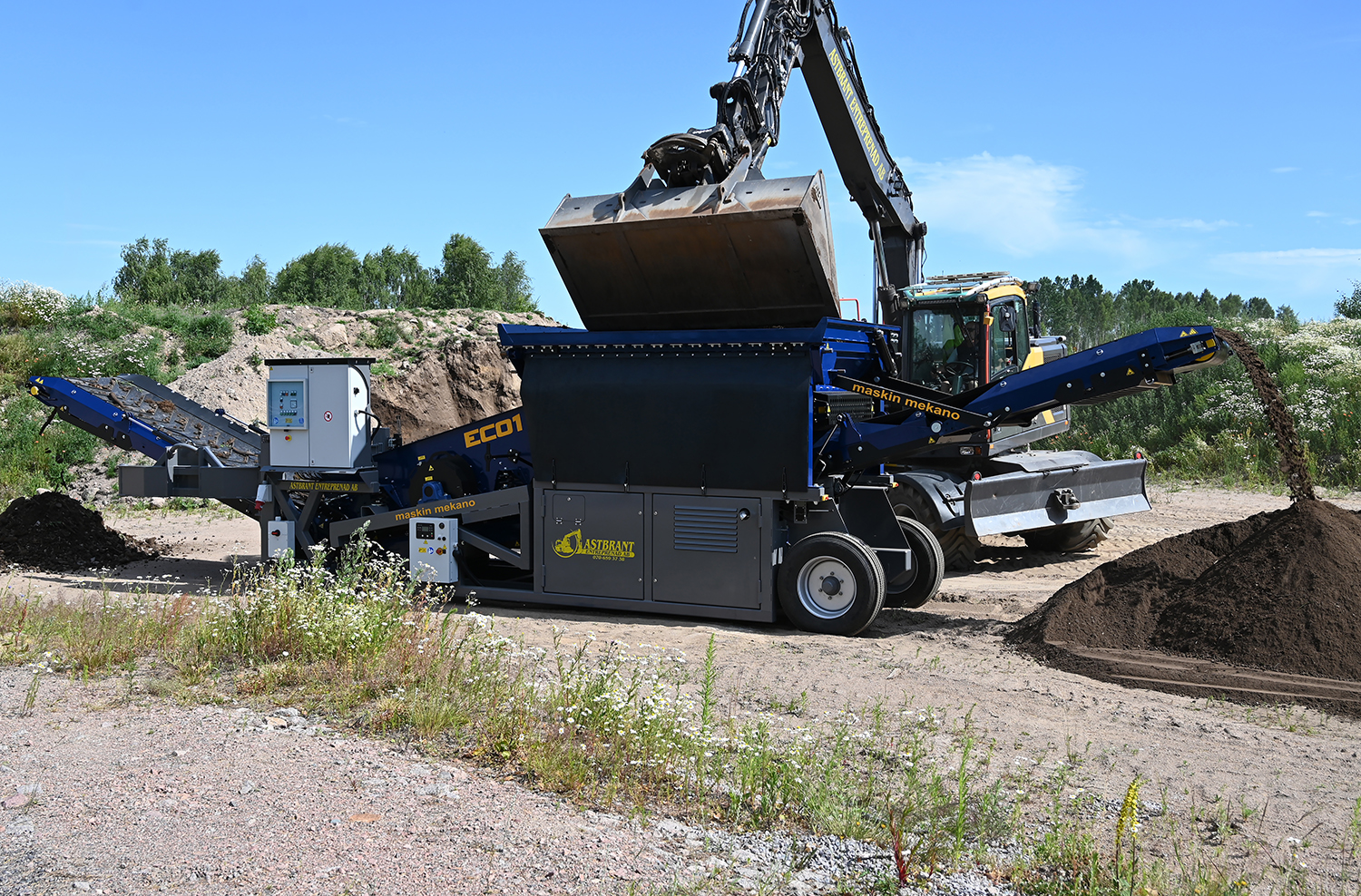
NEW! More info soon. ECO1 is the ideal plant for urban recycling due to its compact size, low noise impact and quick set up time.
As an entrepreneur in today’s circular economy, you have the chance to broaden your services and manage your materials in a smarter way. There is no faster way to increase the value of a material than by sorting it. With your own screening plant that is mobile, cost-efficient, and easy to start up, you can boost your profitability while becoming a key player in building a more sustainable world.
It is an EU stage V water cooled four cylinder dieselmotor driving a 20 kVA generator. The rotation speed is 1500 rpm, so it is both quiet and economic.
How do you change the screening media?
The upper deck is end tensioned and fastened by 2 bolts.
What is the price of a new set of meshes?
Meshes normally cost 300-400 EUR.
What is the feed-in-height of the hopper? What kind of loader is suitable?
The feed-in-height is 2.5 m and the reject grid is 3.1 m wide.
The difference between a belt feeder and a vibrating feeder?
A belt feeder has a great speed interval and is resistant to sticky and wet material, so of you are going to produce mostly top-soil it is a great choice. A vibrating feeder is very sturdy and versatile and can process all kinds of recycling masses and heavier stones. The ECO1 is ideal for those who want to use it in many different applications.
Is it possible to adjust the feeding speed?
Yes, the variable speed driver is controlled via the radio transmitter (also used for tipping of the reject grid).
What parts usually need to be replaced?
The ECO1 is a very robust plant featuring a lot of the same proven components as the larger Maskin Mekano plants. It is essential to retighten the screening media after a while to minimize the strain. If the filters and the oil of the motor are changed according to recommendations and the lubrication points are greased every 40th hour there is usually no need to replace any parts.
How many lubrication points are there? Can it be fitted with centralized lubrication?
It is possible to fit the ECO1 with centralized lubrication, but most customers chose not to since there are only 4 lubrication points that are very accessible and only need to be greased every 40th hour. To lubricate the bearings of the cylinders once every year is also recommended.
What is the weight of the machine?
8.5 tons as standard, in Sweden and most countries it can be transported with a standard hook-lift bogie truck.
The machine is very quiet, how is that possible?
The rotation speed of the diesel generator is only 1500 rpm. The screen box is mounted on a vibration damped frame which prevents the vibrations from the screen from transmitting to the chassis, this also contributes to the low noise impact.

What is the fuel consumption?
The ECO1 has a fuel consumption of only 2.2 l/h.
The machine is very quiet, how is that possible?
The rotation speed of the diesel generator is only 1500 rpm and it is also noise insulated. The screen box is mounted on a vibration damped frame which prevents the vibrations from the screen from transmitting to the chassis, this also contributes to the low noise impact.

How long is the set-up-time?
For transport mode the feeder is lowered and the conveyors folded, this is done hydraulically without any need for any manual handling. It is ready for transport in 5 minutes and ready for production in the same time.
And the capacity?
And the capacity?
The ECO1 is suitable for a vast range of recycled material such as asphalt, concrete, landfill and so on, but also for building material and scrap and of course traditional sorting tasks. The capacity when producing top soil is 30-150 tones/h, depending on how moist the material is. For other materials the capacity is usually between 100-200 tones/h.